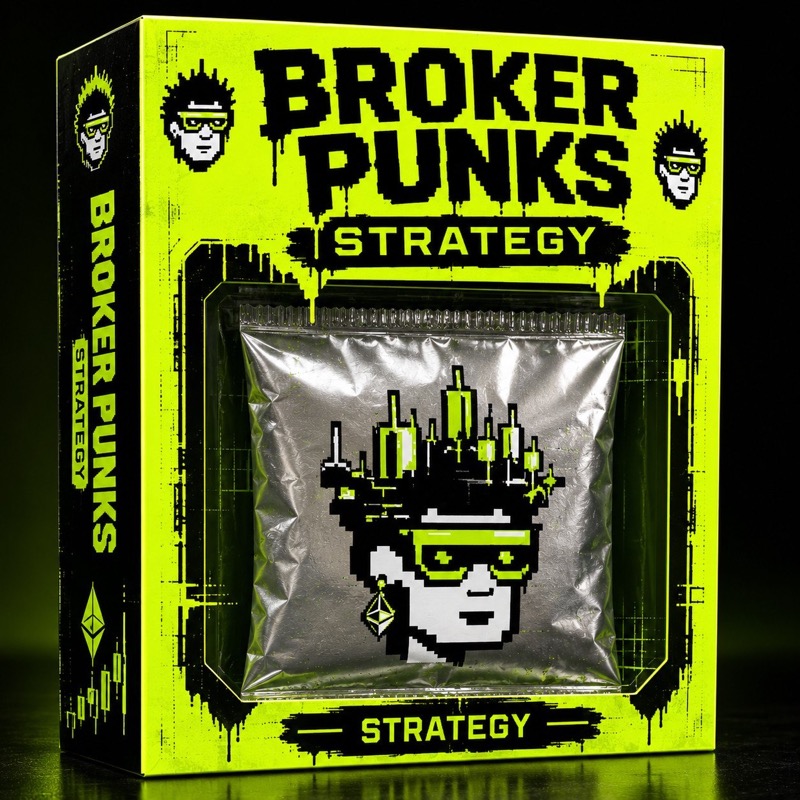
Every trade
buys a punk
and burns supply
A 10% fee sits on the $BPSTR pool. Eight points of it fund a machine that sweeps Broker Punks off the OpenSea floor and puts them straight back up at 1.2x. When one sells, the whole payment buys $BPSTR and destroys it. The loop needs no manager and no treasury deposit, only volume.
// THE MECHANISM
Six steps, then repeat
The machine is a set of rules, not a fund. It holds ETH it cannot pay out to anyone and punks it can only sell on a public marketplace.
Somebody trades
Any buy or sell against the $BPSTR pool pays a 10% fee, taken in ETH by the pool hook rather than by the token. Wallet to wallet transfers pay nothing.
The fee splits 8 and 2
Eight points of the trade land in the machine, two go to the team. The split is fixed at deployment. There is no owner on the hook and no setter to change it.
A punk comes off the floor
The operator fills a live OpenSea listing straight from the treasury. The contract re-checks that it owns the punk afterwards and that it did not overspend, so a bad order can only revert.
It goes back up at 1.2x
The punk is relisted on OpenSea at 1.2 times what the machine paid. The vault does not sell in-contract at all, so price discovery stays where the collection already trades.
The sale burns supply
Seaport pays the machine, and that money is fenced for burning the moment it arrives. All of it buys $BPSTR through the pool and destroys it. None of it can fund the next punk.
Round again
Trading refills the treasury while the burn shrinks the supply. Nobody has to deposit anything for the loop to keep turning, and nobody can withdraw from it.
// THE MACHINE
What it has done so far
Read straight off Robinhood Chain in your browser. There is no server between this page and the contract.
Flow
- Fees taken, all time
- - ETH
- Of which to the machine
- - ETH
- Spent on punks
- - ETH
- Returned by sales
- - ETH
- Waiting to be burned
- - ETH
Supply
- Genesis supply
- -
- Circulating now
- -
- Burned
- -
- Share destroyed
- -
- Cycles completed
- -
Settings
- Trade fee
- -
- Relist markup
- -
- Most it will pay per punk
- no cap set
- Sale proceeds burned
- 100%
Addresses
- $BPSTR token
- 0x82E71bE5184cA73a83eB6623C57Faa38CD1F1F53
- Broker Machine
- 0xAeb3CF66ff3BCc0904AE5C5fB4B1DF5936EEF861
- Liquidity locker
- 0xf350Fa1B36479E1C3FA1fEACCD3c186Ed429ee61
- Broker Punks
- 0xe6F39752438D607390b339CDB609144AcEa6D6DB
// THE VAULT
Punks on the shelf
Everything the machine is holding right now, each one listed on OpenSea at 1.2x what it paid. Buy one there and your ETH does not reach the team or a treasury. All of it buys $BPSTR and destroys it.
// TOKENOMICS
The numbers, in full
Nothing here is adjustable after launch except the relist markup and the ceiling on what the machine will pay for one punk. The fee, the split and the locked position are fixed in the contracts.
Supply
| Ticker | $BPSTR |
| Total supply | 1,000,000,000 |
| Decimals | 11 |
| In the locked pool | 100% of supply |
| Team allocation | none |
| Presale | none |
| Mint function | none, the supply can only fall |
The pool
| Pair | ETH / BPSTR, Uniswap V4 |
| Pool fee tier | 1% |
| Opening price | 420,901,191 BPSTR per ETH |
| Supply at that price | about 2.38 ETH |
| ETH placed at launch | 0 |
| Position range | -887,200 to 37,200 |
| Liquidity withdrawal | no function exists |
The flow
| Trade fee | 10%, in ETH, both directions |
| Fee to the machine | 80% of the fee, so 8% of the trade |
| Fee to the team | 20% of the fee, so 2% of the trade |
| Wallet transfers | untaxed |
| Relist markup | 1.2x what the machine paid |
| Sale proceeds | 100% burned |
$BPSTR is not backed by the punks the machine holds and gives no claim on them, on the treasury, or on anything else. The machine is a mechanism that follows its own code: it buys, it relists, it burns. Whether any of that is worth anything is a question the market answers, not this page. The contracts are unaudited.
// QUESTIONS
Reasonable objections
Is $BPSTR backed by the punks?
No. The token gives no claim on the punks, the treasury or anything else. The machine holds assets it cannot pay out to token holders, and there is no redemption function. What the token has is a mechanism attached to it: trading funds purchases, and sales destroy supply.
Where does the 10% go?
Eight points of every trade go to the machine and two go to the team, both in ETH. The fee is charged by the pool hook, not by the token, so moving $BPSTR between wallets costs nothing. The hook has no owner and no setter, so the rate cannot be changed later.
Can anyone withdraw the treasury?
There is no function to. The machine has no withdraw, no ETH rescue, no upgrade path and no proxy. ETH leaves it in exactly two ways: buying a punk, or buying $BPSTR to burn. The ERC20 rescue function explicitly refuses $BPSTR.
Can the liquidity be pulled?
No. The launch position is held by a locker contract that has no removal function at all, not owner-gated and not timelocked, simply absent. The only thing that can leave the locker is the swap fee the position earns, and that is forwarded to the machine.
Why does the operator have to press a button to buy?
Choosing which listing to fill needs an order built off-chain, so a person requests it and the contract executes it. What the operator cannot do is take the money: the buy reverts unless the machine actually ends up owning the punk, and the ceiling on the price is set on-chain.
Why does the machine not sell punks itself?
Because the punks should trade where the collection already trades. The vault lists on OpenSea and has no in-contract sale path at all. The contract has no private key, so it vouches for each listing individually under EIP-1271 rather than signing a blanket approval.
Who can settle a sale?
Anyone. The settle function checks the one thing nobody can fake, that the machine no longer owns a punk it still has listed, and then burns the proceeds. Even if nobody calls it, the money is already fenced for burning the moment Seaport pays it in.
Why 11 decimals?
It is what places the opening tick where the whole supply is worth about 2.38 ETH at launch. Decimals and the tick are two halves of one number here. Changing either without the other moves the launch price by orders of magnitude.
Is this audited?
No. The contracts are unaudited. Read them on the explorer before deciding anything, and treat the whole thing as experimental.